

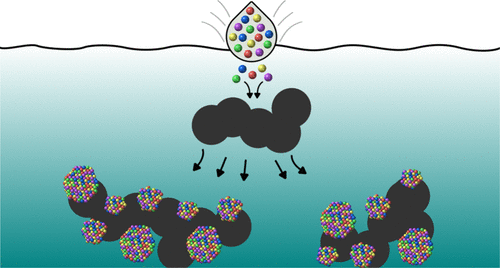
High-entropy alloys (HEAs) are attracting global attention as a new class of materials with exceptional potential in electrocatalysis. A recent study led by Kirsten Jensens team, introduces a simple and environmentally friendly method to synthesize ultrasmall HEA nanoparticles—just 1–3 nanometers in size—using a water-based hot-injection approach with L-ascorbic acid as the reducing agent. The nanoparticles, composed of IrPdPtRuRh, form directly on a carbon support and exhibit a mean crystallite size of only 1.2 ± 0.7 nm. Importantly, all five elements are uniformly distributed, with no signs of segregation.
These supported HEA nanoparticles outperform conventional Pt/C catalysts in the alkaline hydrogen evolution reaction, requiring 30 mV less overpotential to reach 10 mA cm⁻² ECSA. Kinetic studies reveal a strong synergistic effect between the carbon support and the reducing agent, accelerating metal reduction rates significantly.
Our group made key contributions to this work:
Espen Bøjesen, Rebekka Klemmt, and Rasmus Rohde applied advanced 4D-STEM techniques to confirm the crystalline nature of these ultrasmall particles, and performed STEM and STEM-EDX analyses to determine particle size and verify elemental mixing—critical steps in validating the material’s unique structure.
This breakthrough opens new pathways for designing sustainable, high-performance catalysts for energy applications.
Read the paper here:
https://pubs.acs.org/doi/10.1021/acs.nanolett.5c03515
 DISORDER Group
Leave a comment